
Shooting politicians into the Sun is a bad idea!
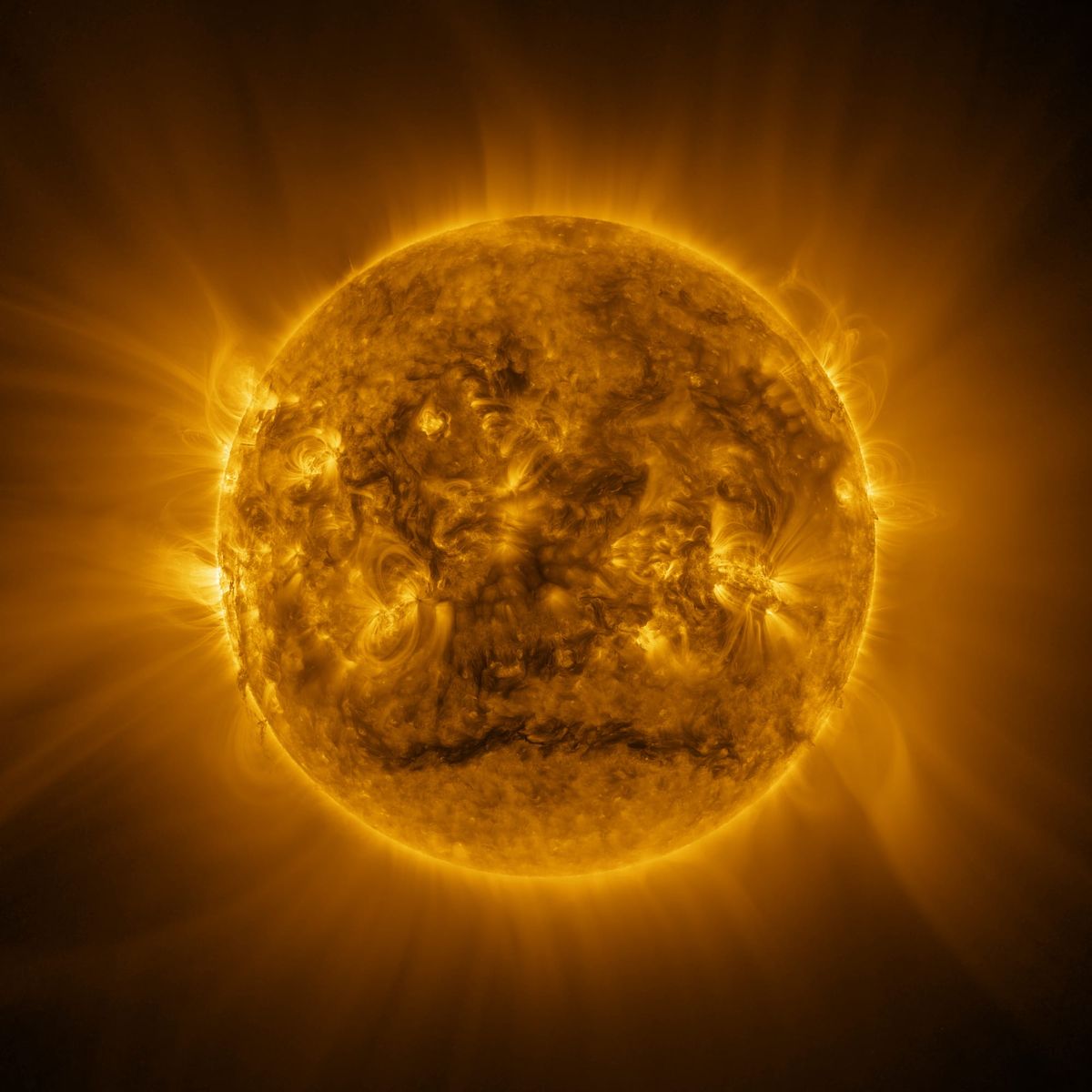
It is a very tempting fantasy, but we ought to be energy efficient.
The present age is a mixed bag, to say the least. Corrupt, useless, and just plain evil politicians have existed for as long as we had politicians, but it feels that we are experiencing a surplus at the moment.
It is not surprising to see people wishing to catapult those politicians straight into our nearest star. I understand the sentiment, but as an astrophysicist, I have to say, no!
Don’t get me wrong, it’s not about moral qualms. It’s a matter of celestial mechanics. It takes a lot of energy to go to the Sun!
It seems so absurd. The Sun is the biggest gravitational body in the solar system; wouldn’t it be like going downhill towards it? Yes, if you start in a perfectly still position. But no rocket does.
Anything launched from Earth carries with itself the velocity that our planet has going around the Sun (plus or minus the speed of the rocket). That's 107,000 kilometers per hour, or 30 kilometers per second.
The velocity of rockets to escape the pull of Earth for good is about one-third of that. Only the biggest, most powerful rockets, those sending interplanetary missions or going to the Moon, reach those speeds. It takes a lot of fuel!
If you want to fall directly into the Sun, you’d have to use the rocket engine to slow you down massively; that would be adding a lot more fuel, making the rocket a lot bigger, which would need more fuel to liftoff, etc.
There is an alternative approach and might be apt for many of those politicians. It involves theft on a planetary scale.
Slingshotting to the centre
To move closer or farther away from the Sun and save the most fuel, you need to go past planets. This is a technique known as gravity assist or gravitational slingshot, where the speed and path of a spacecraft are altered by going close to a planetary object and stealing some of the momentum from the world targeted.
It's a bit like a bouncy collision, but a lot more controlled. The craft gets into the gravitational well of the planet; some orbits provide the change without the need to fire engines, but in other cases, a little engine boost gives you a lot more punch for your pound.
We have used this technique across so many space missions it has become routine. The first one was Luna 3 to go photograph the far side of the Moon. The first interplanetary mission to use the gravity assist was Mariner 10, to Mercury. It slingshotted around Venus and then did three flybys of Mercury.
The person that worked out the right trajectory that allowed Mariner 10 to meet Mercury three times was Italian mathematician and engineer Giuseppe 'Bepi' Colombo.
His name is now immortalised in the BepiColombo mission, which is now almost at Mercury after almost 8 years of travel. This week, BepiColombo dropped one-third of its spacecraft (its propulsion module) as it readies to enter orbit in a few months.
This is the inspiration of this fortnightly newsletter... well that and those politicians!