
We have found more space rainbows than you might think - this is not one of them!
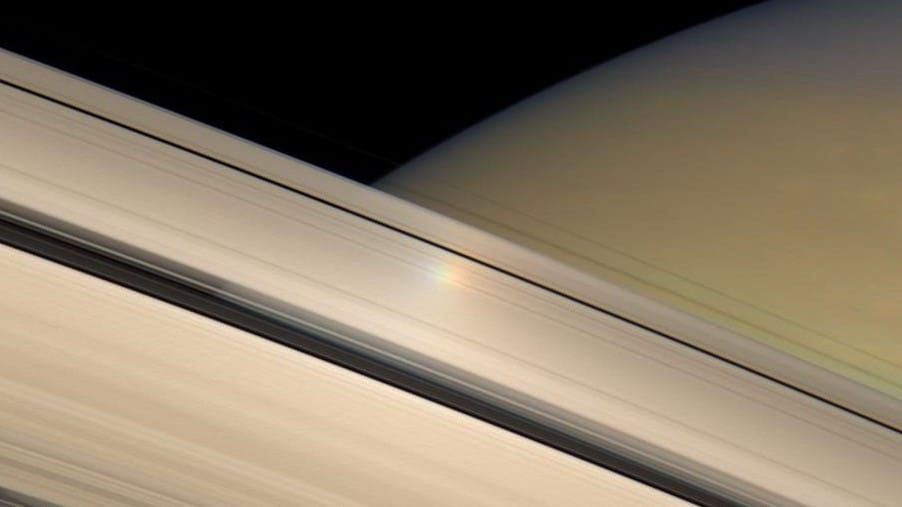
ple of months, I have seen the image above several times, and I had several friends sending it to me. Completely fair, you do not write an astronomy book called Invisible Rainbows without becoming “the space rainbow person." Unfortunately, we are not seeing a rainbow here.
And it's not that I am being difficult or that this isn’t a rainbow-like effect. If we were there in a spacecraft, we would see something very different: just a spot of light. The image above was taken by the Cassini mission, one of my top favourite space missions. The camera on Cassini doesn't see color like we do, but it takes progressive exposures in red, green, and blue filters.
What we are seeing is called ‘the opposition effect.' When the Sun is right behind or very close to being right behind the spacecraft, a bright spot appears on the rings of Saturn. Since Cassini moved pretty fast, the spot is turned into a little rainbow in the images.
The image remains gorgeous, and knowing that the rainbow itself is not really there doesn't take away from its beauty. In my opinion, it adds.
Please, Not Another Invisible Rainbow!
There are plenty of phenomena that are similar to rainbows in the universe. Light can get refracted, reflected, and dispersed by a variety of substances across the full spectrum.
But what about real bona-fide rainbows like the one on Earth? Unfortunately we have not found any of those because we have not found water rain anywhere else yet.
The closest thing we have found is known as a glory. Glories, like rainbows, are colourful events, but they are produced by the scattering of light on (usually) water droplets. The droplets have to be spherical (so most likely liquid) and roughly the same size.
Usually, they appear around a person's shadow at sunrise and sunset of low clouds or fog, creating a halo around a person just like saint iconography: hence glory! Often, you can see them on clouds around the shadow of a plane: that's called the glory of a pilot.
Well, it turns out that you can find glories on a much larger and more distant scale.
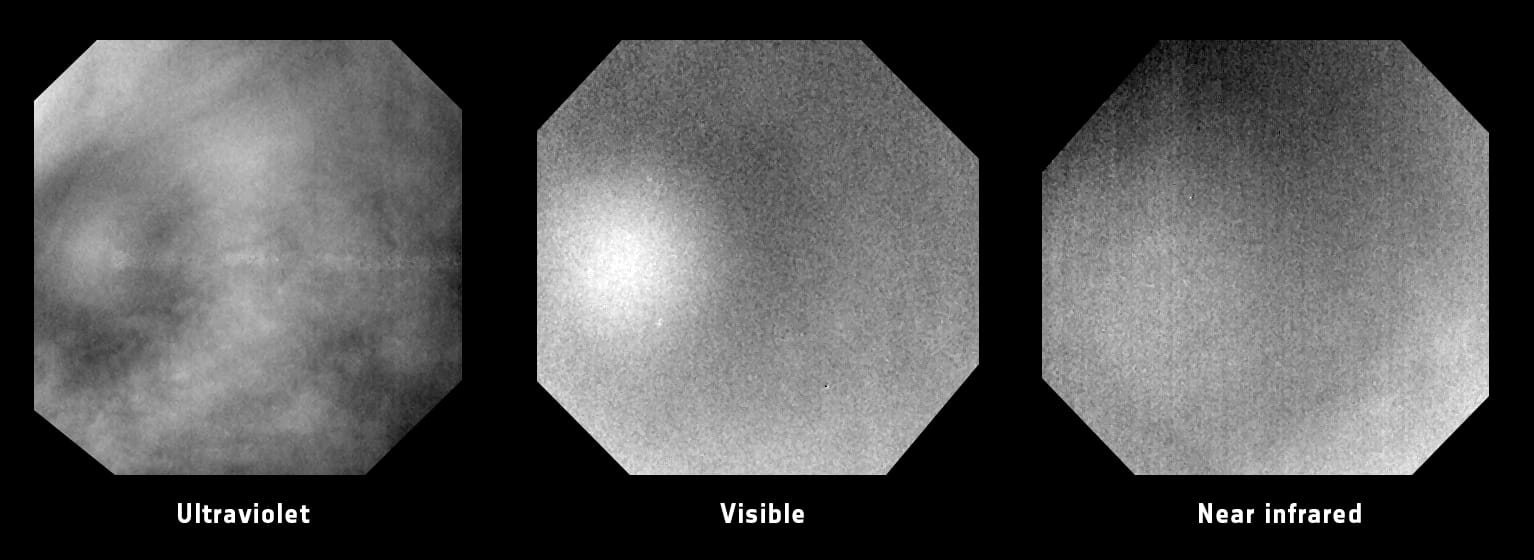
First, there's Venus. The ESA mission Venus Express actually looked for a glory on purpose to better work out the composition of the Venusian atmosphere. They did find the glory back in 2014, across different wavelengths of light.
Even more excitingly, we have found a much more distant candidate glory, 620 light-years away. Exoplanet WASP-76b is a super-hot Jupiter. It's a gas giant orbiting so close to its star that it rains molten iron and other metals. Its atmosphere is expected to be made of grey clouds, and at the edge between the day-side and night-side, there is what appears to be a glory.
If confirmed, it would be the first extrasolar glory. And proof that you can always improve something with a splash of color!
Eclipse Next Week - Time To Get Ready
On August 12, there will be a total solar eclipse across the Arctic, Iceland, and Spain. Across Europe and the eastern side of America, it will be partial, so if you are in those locations now, it is the time to get solar glasses!
Here are some other tips!
 Alfredo Carpineti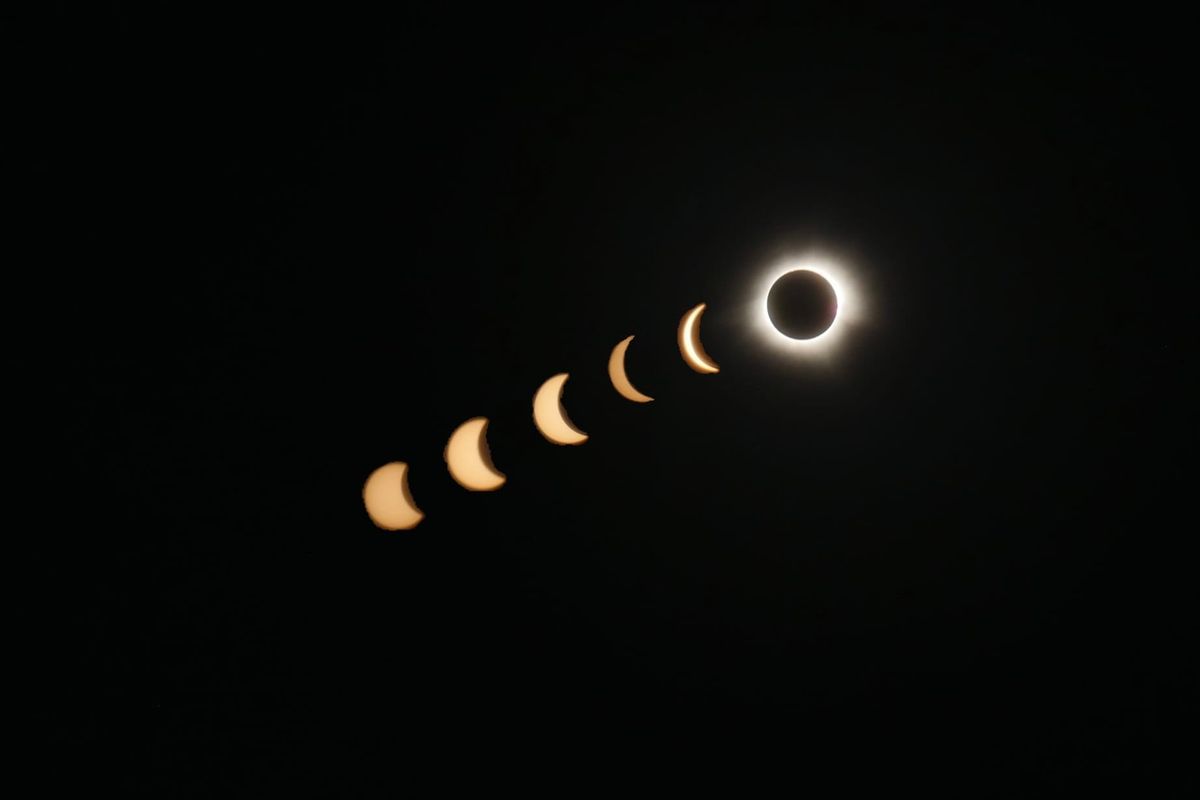
I am doing the Edinburgh Book Fringe on August 30!